How Vessel Count Affects Brewing Time and Labour
Two breweries with the same tanks can have very different working days, and the difference is usually the number of vessels on the hot side. HGMC builds brewhouses in 2, 3, 4 and 5-vessel configurations, and each extra vessel is really a way of buying back time: lautering can overlap boiling, the next mash can start while the previous one is still in the kettle, and the crew stops waiting on a single vessel to finish. Fewer vessels mean less cleaning and a cheaper build; more vessels mean more brews in a week.
Key takeaways
- Published configurations run from 2 to 5 vessels, with steam, direct-fire or electric heating and decoction or infusion brewing supported.
- Overlapping lautering with boiling is what turns two brews a day into three, which is a 50 per cent gain on the same floor.
- Each vessel adds cleaning and inspection time, so a bigger set needs a planned cleaning rota rather than an improvised one.
- Automatic control of mash, wort and water flow keeps the sequence repeatable when the vessel count rises.
What each vessel adds to a brew day
A two-vessel set combines mash and lauter in one tun and kettle and whirlpool in another, so the steps take turns: mash, lauter, boil and whirlpool all queue behind each other. A three-vessel set usually separates the whirlpool, which lets the kettle empty faster and the next lauter begin sooner. Four and five-vessel lines separate the mash mixer, the lauter tun, the kettle and the whirlpool, so several stages run at once and the day stops being a queue.
Brewhouse design is a labour decision as much as an equipment decision: each extra vessel buys time back on brew day, and each vessel you leave out saves cleaning but costs throughput. The right trade is the one that matches the number of brews your sales actually need.
Sequencing: overlapping lautering with boiling
The critical overlap is between lautering and boiling. On a two-vessel line the kettle waits until the lauter is complete, so the day has a long dead patch in the middle. Once the lauter tun and the kettle are separate vessels, the second batch can be lautering while the first is boiling, and the equipment stops sitting idle. That single change is where most of the extra output in a three-vessel set comes from.
Control level decides how smoothly that overlap runs. The published options include a PID display panel, a PLC semi-automatic touch screen and a PLC fully automatic panel with curve indication and production-record printing. On automatic lines the mash, wort and water flow are controlled together with automatic temperature control, which is what makes a tight sequence repeatable on a shift where the brewer is also cleaning, filling casks and answering the phone.
Cleaning, turnarounds and the hidden labour
Every vessel on the hot side has to be cleaned between uses, and a clean is a fixed block of work regardless of batch size. That is the counterweight to the overlap argument: a five-vessel line has more surfaces, more valves and more pipe runs to clean, and if the cleaning rota is written after commissioning it will be improvised every afternoon. Write it on the drawing instead, vessel by vessel, and give each one an owner.
Whirlpool behaviour belongs in the same picture. The whirlpool gathers trub and hop material before the wort is knocked out, and how well it does that shapes clarity, yield and how long the next clean takes. A dedicated whirlpool vessel gives the wort a proper rest and a tidy cone of solids; a combined kettle and whirlpool asks one vessel to do two jobs, which is cheaper to buy and slower to run. Published designs pay attention here, with jackets on the body and cone and pipework laid out to limit aeration as the wort moves, and those details show up in the brewery's yield and in the shelf life of the beer as much as in the brew day timings.
Turnaround time between brews is the number to measure. Collect it on a clipboard for a week: fill, boil, whirlpool, knockout, clean, ready. Most breweries find the gap between "ready" and "brewing again" is bigger than the brewing itself, and that gap is where vessel count and a sensible cleaning routine pay off.
Fabrication detail matters for how that routine goes. The published build uses TIG 100 percent full welding joints and polishing accuracy of 0.4 micrometres or finer, in stainless steel 304 or 316 with 3 mm and 2 mm plate, all of which makes cleaning easier — a rough internal surface holds soil and lengthens every clean.
| Configuration | Sequencing effect | Cleaning points |
|---|---|---|
| 2-vessel | Steps queue: lautering blocks boiling | Fewest surfaces, simplest rota |
| 3-vessel | Lautering overlaps boiling | One more vessel and its valves |
| 4-vessel | Dedicated mash mixer frees the lauter tun | Two additional vessels to clean each turn |
| 5-vessel | Next mash can start during the previous boil | Rota and ownership matter most here |
Worked example: two brews or three in a day
Example, with assumptions stated. Suppose a two-vessel line runs two brews in a normal brew day and a three-vessel line runs three, both at 1,000 litres. Over five brew days a week that is 2 × 5 = 10 brews against 3 × 5 = 15 brews, so 10,000 litres against 15,000 litres a week.
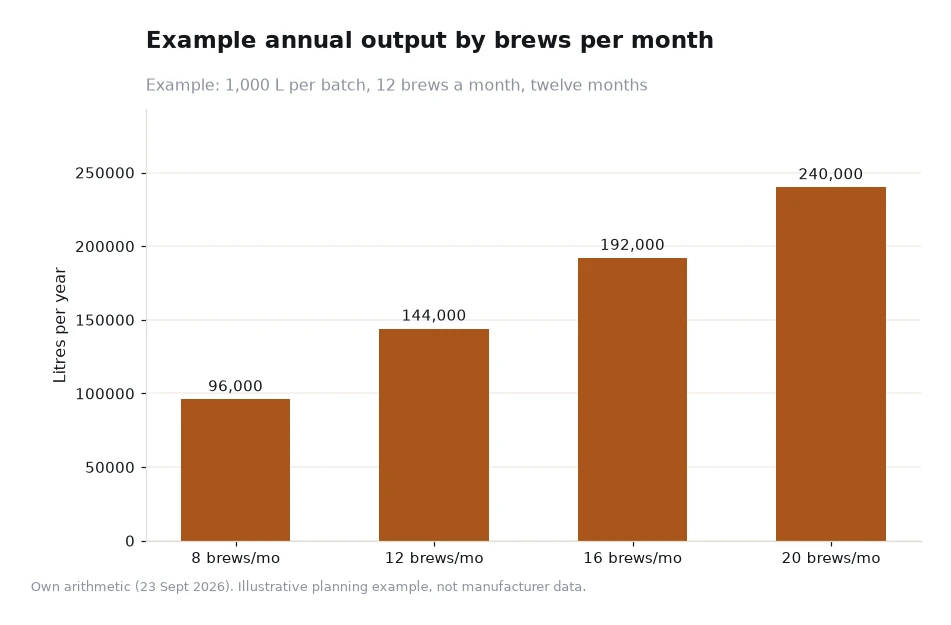
Put monthly rhythms on the same line and the spread widens: eight brews a month on 1,000 litres is 8 × 1,000 × 12 = 96,000 litres a year, twelve brews is 144,000 litres, sixteen is 192,000 litres and twenty is 240,000 litres — the four bars in the chart below. Against that, cleaning labour: at about 30 minutes a vessel per turn, a two-vessel line spends 60 minutes cleaning per brew and a three-vessel line 90 minutes, so the third brew costs 30 more minutes of cleaning and returns 1,000 litres. The figures assume no losses and a full crew on brew day.
Frequently asked questions
Does a three-vessel brewhouse really brew faster than a two-vessel one?
It usually fits more brews into the same day rather than shortening the brew itself. Separating the vessels lets lautering overlap boiling, so a line that manages two brews a day can often manage three.
How much extra cleaning does each vessel add?
Treat cleaning as a fixed block per vessel per turn: at roughly 30 minutes a vessel, a two-vessel set spends about 60 minutes cleaning each brew and a three-vessel set about 90. Those figures are examples, not published data.
Choosing between configurations
Start from sales, not from the drawing. Work out how many brews a week your forecast needs, add the cleaning and turnaround time you can realistically staff, and then choose the configuration that fits that number. A two-vessel set with spare tank capacity will serve a taproom happily; a brewery chasing wholesale accounts usually wants three or more vessels sooner than it expects to.
Two planning resources make the decision easier. The published HGMC site describes how brewhouses are configured across the size range, the grouping on the brewery-system pages shows what changes with capacity, and the brewing equipment section covers the control and heating choices behind the vessels. Free 2D, 2.5D and 3D design work then shows whether the extra vessel and its pipework will actually fit the room.
Published figures come from the manufacturer's own website, read 23 Sept 2026: the 2, 3, 4 and 5-vessel configurations, the electric, steam and direct-fire heating options, decoction and infusion support, the PID and PLC control levels with production-record printing, the TIG welding and polishing accuracy, the 304 and 316 stainless plate thicknesses, the 90–150 day deposit-to-door window, and the 6-year warranty on tank accessories and electronic components against manufacturing defects from the factory, used within scope. The brew counts, cleaning times and annual output bars are this article's own labelled examples.[1]