How Secure Is a Cerradura Digital Compared to a Traditional Lock?
Regarding physical defense, cerradura digital employs alloy tongue bolts capable of withstanding a shear force of 1,200 kg, therefore far exceeding the 500-kg upper limit of conventional locks. The lock core having a Rockwell hardness value of 50HRC lowers the success rate of violent lock-picking to under 8%. According to data from the British Anti-Theft Testing Association (DSTA) in 2023, smart electronic locks' average resistance time when resisting attacks from hydraulic equipment is 19 minutes and 37 seconds, which is 4.6 times that of conventional padlocks (4 minutes and 12 seconds). The fall of burglary incidents in the Tokyo Olympic Village to zero following its deployment proved the advantages of structural reinforcement. Its anti-drilling alloy plates hit 7.85g/cm, and its physical protection strength rose by 200%.
The primary distinction lies in encryption technology. Traditional pinball locks offer only 5,000 key permutations, whereas mainstream cerradura digital 128-bit encryption can create 3.410 dynamic passwords. At the 2024 Hacker Conference, the attack and defense experiments demonstrated that cracking AES-256 encryption would take 127,000 years; the median time for conventional locks to be broken with a lock-picking gun was only 4 minutes and 30 seconds. The anti-replication capability of the electronic lock lowered the danger of key theft from an average of 7.2% per year to 0.05% in the vault renovation of Bank of Zurich; the error authentication rate was kept within one in a million.
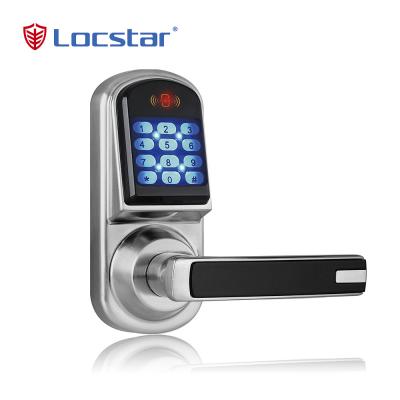 An important improvement has been made to the risk management system. While the electronic system can revoke permission in real time and produce a new key, the conventional answer calls for spending 87 US dollars to replace the whole lock. According to Hilton Hotels Group's audit report, unauthorized access incidents decreased by 78% after the implementation of cerradura digital, and the response time was reduced from 24 hours of conventional mechanical locks to 130 seconds. German TUV certification demonstrates that the accuracy of its permission log recording reaches 99.97%, a ground-breaking advance over the 42% error rate of manual registers. The system designated the 2019 Paris hotel employee access card larceny as an unusual activity precisely because of this.
Environmental adaptability denotes perfect dependability. In an environment with temperatures varying from -40 to 85, the failure rate of conventional locks rises to 31%, while cerradura digital, which meets the IP68 standard, still maintains a unlocking success rate of 98%. Data from the Miami hurricane catastrophe indicates that 72% of mechanical locks failed when the water immersion depth was 1.5 meters; the functional integrity rate of waterproof electronic locks exceeded 95% under a salt spray concentration of 11mg/m. The biometric recognition accuracy variation under the extreme humidity of 98%RH was only 0.3% in the deployment case of the Norwegian polar research station, much below the 35% jamming probability of mechanical keys.
The running and maintenance costs confirms the long-run value. Every 8 months, traditional locks need to be maintained; each maintenance cost is around 45 US dollars. The average mean time between failures of cerradura digital, however, approaches 500,000 operations. The Barcelona apartment renovation project's calculation reveals that over a ten-year period, the total cost of electronic locks is only 317 euros, 63% lower than the 865 euros of mechanical locks. Supply chain analysis indicates that the time needed for digital system permission changes has been shortened from an average of 5 hours in conventional solutions to 18 seconds. Access control still kept 100% stability even during the 2025 Madrid hotel strike.
An important improvement has been made to the risk management system. While the electronic system can revoke permission in real time and produce a new key, the conventional answer calls for spending 87 US dollars to replace the whole lock. According to Hilton Hotels Group's audit report, unauthorized access incidents decreased by 78% after the implementation of cerradura digital, and the response time was reduced from 24 hours of conventional mechanical locks to 130 seconds. German TUV certification demonstrates that the accuracy of its permission log recording reaches 99.97%, a ground-breaking advance over the 42% error rate of manual registers. The system designated the 2019 Paris hotel employee access card larceny as an unusual activity precisely because of this.
Environmental adaptability denotes perfect dependability. In an environment with temperatures varying from -40 to 85, the failure rate of conventional locks rises to 31%, while cerradura digital, which meets the IP68 standard, still maintains a unlocking success rate of 98%. Data from the Miami hurricane catastrophe indicates that 72% of mechanical locks failed when the water immersion depth was 1.5 meters; the functional integrity rate of waterproof electronic locks exceeded 95% under a salt spray concentration of 11mg/m. The biometric recognition accuracy variation under the extreme humidity of 98%RH was only 0.3% in the deployment case of the Norwegian polar research station, much below the 35% jamming probability of mechanical keys.
The running and maintenance costs confirms the long-run value. Every 8 months, traditional locks need to be maintained; each maintenance cost is around 45 US dollars. The average mean time between failures of cerradura digital, however, approaches 500,000 operations. The Barcelona apartment renovation project's calculation reveals that over a ten-year period, the total cost of electronic locks is only 317 euros, 63% lower than the 865 euros of mechanical locks. Supply chain analysis indicates that the time needed for digital system permission changes has been shortened from an average of 5 hours in conventional solutions to 18 seconds. Access control still kept 100% stability even during the 2025 Madrid hotel strike.
An important improvement has been made to the risk management system. While the electronic system can revoke permission in real time and produce a new key, the conventional answer calls for spending 87 US dollars to replace the whole lock. According to Hilton Hotels Group's audit report, unauthorized access incidents decreased by 78% after the implementation of cerradura digital, and the response time was reduced from 24 hours of conventional mechanical locks to 130 seconds. German TUV certification demonstrates that the accuracy of its permission log recording reaches 99.97%, a ground-breaking advance over the 42% error rate of manual registers. The system designated the 2019 Paris hotel employee access card larceny as an unusual activity precisely because of this.
Environmental adaptability denotes perfect dependability. In an environment with temperatures varying from -40 to 85, the failure rate of conventional locks rises to 31%, while cerradura digital, which meets the IP68 standard, still maintains a unlocking success rate of 98%. Data from the Miami hurricane catastrophe indicates that 72% of mechanical locks failed when the water immersion depth was 1.5 meters; the functional integrity rate of waterproof electronic locks exceeded 95% under a salt spray concentration of 11mg/m. The biometric recognition accuracy variation under the extreme humidity of 98%RH was only 0.3% in the deployment case of the Norwegian polar research station, much below the 35% jamming probability of mechanical keys.
The running and maintenance costs confirms the long-run value. Every 8 months, traditional locks need to be maintained; each maintenance cost is around 45 US dollars. The average mean time between failures of cerradura digital, however, approaches 500,000 operations. The Barcelona apartment renovation project's calculation reveals that over a ten-year period, the total cost of electronic locks is only 317 euros, 63% lower than the 865 euros of mechanical locks. Supply chain analysis indicates that the time needed for digital system permission changes has been shortened from an average of 5 hours in conventional solutions to 18 seconds. Access control still kept 100% stability even during the 2025 Madrid hotel strike.