The Documents Behind a Compliant Fragrance Launch
Compliance is not a certificate handed over at the end; it is a set of documents assembled while the product is being developed. The list changes by market, by format and by claim, but the categories are stable: what is in the product, what it is permitted to contain, how it was made, and what can safely be said about it. A brand that knows those categories can audit a supplier's pack in an afternoon.
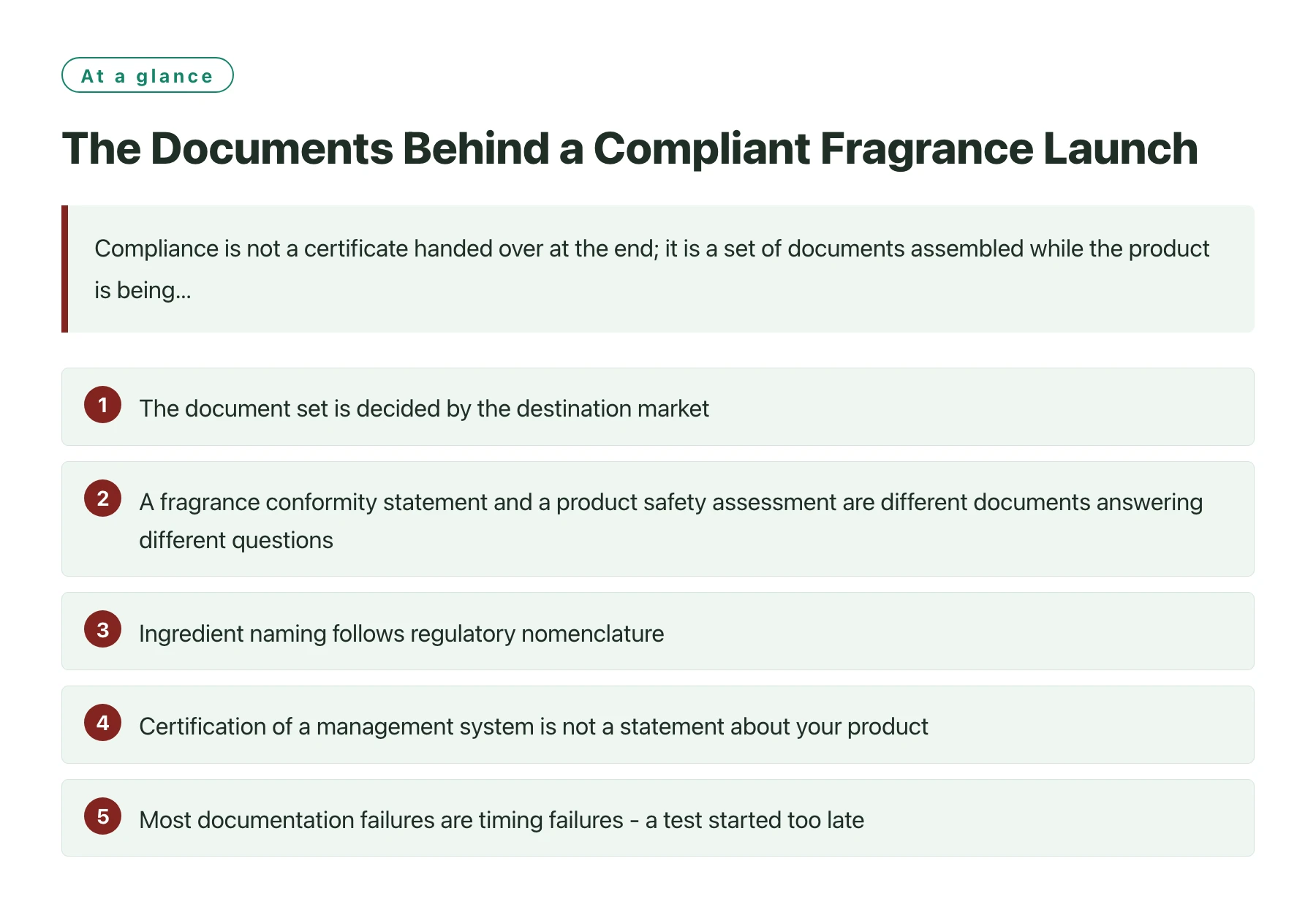
Key takeaways
- The document set is decided by the destination market, so the markets belong on the first page of the brief rather than in a shipping conversation later.
- A fragrance conformity statement and a product safety assessment are different documents answering different questions; suppliers sometimes present one as the other.
- Ingredient naming follows regulatory nomenclature, which is why the INCI list and the internal formula reference rarely look alike.
- Certification of a management system is not a statement about your product; it describes how the factory is run.
- Most documentation failures are timing failures - a test started too late, a translation ordered after the pack was printed - rather than missing capability.
Brands usually meet the documentation list at the worst possible moment: when the artwork is about to go to print and the importer asks for something nobody has. Reordering that sequence is the entire benefit of treating documents as a development workstream.
The map below is a working checklist rather than a legal text. Exact requirements vary by jurisdiction and by product, and a qualified safety assessor or regulatory consultant should confirm what applies to your specific product.
The document map
| Document | What it establishes | Who normally issues it |
|---|---|---|
| Formula specification | The composition, dosage and material references of the fragrance | The fragrance house or the manufacturer |
| Fragrance conformity statement | That the fragrance complies with the applicable IFRA Standards for its product category | The fragrance supplier |
| Product safety assessment | That the finished product is safe for its intended use | A qualified safety assessor |
| Ingredient declaration (INCI) | The label-ready names of the ingredients present | The formulator, using the regulatory nomenclature in force, such as the EU CosIng database [2] |
| Allergen declaration | Which fragrance allergens are present above the labelling threshold | The manufacturer, calculated from the formula |
| Test reports | Stability, pack compatibility and microbiological results where applicable | The manufacturer or an accredited laboratory |
| Market notification or registration | That the product has been placed on the market in line with local rules, such as the notification expected under Canada's cosmetics framework [3] | The brand or its in-market responsible party |
| GMP or system certificate | That the manufacturing system has been audited against a recognised standard | An independent certification body |
Notice that only two of these eight documents come from the factory's own quality system. The rest are produced by, or depend on information from, the fragrance supplier, the testing laboratory, the assessor and the brand.
The three documents people confuse most often
Documentation problems are rarely about documents that do not exist. They are about documents being read as something they are not.
Conformity is not safety
A fragrance conformity statement addresses the fragrance compound against the IFRA Standards, which set maximum use levels for fragrance materials by product category and are supported by the association's published work on safe use and fragrance science [1]. A product safety assessment addresses the finished product as sold, including the pack, the dosage and the intended use. Both are needed; neither substitutes for the other.
A system certificate is not a product document
A GMP or management-system certificate describes how a site is organised and audited. It says nothing about whether a particular formula sits inside a use limit or whether a particular label is compliant in a particular country. Buyers who accept a certificate in place of product documentation tend to discover the difference at customs.
An ingredient list is not a formula
The INCI list is written for consumers and regulators, in a standardised order, with fragrance components largely collapsed into the word parfum. It cannot be used to reproduce the product, and it is not intended to be. The formula reference and the ingredient declaration serve different readers, which is why a supplier may legitimately provide one and withhold the other.
Scientific opinions sit behind the limits
Many of the restrictions a brand encounters originate in scientific assessment rather than in marketing preference. In the EU, the Scientific Committee on Consumer Safety publishes opinions on substances that inform how those substances may be used in cosmetic products [4]. Knowing that the limits come from toxicological review makes it easier to accept that they are not negotiable with a supplier.
Build the document list at brief stage as a table with three columns: document, market, owner. Then treat each row as a task with a date. The two rows that most often slip are third-party testing, because it sits in someone else's queue, and translations or label adaptations, because they are ordered after the artwork is otherwise finished.
Where the list changes by market
Three variables move the list: where the product is sold, what it claims, and how it is applied. A fine fragrance spray for the EU, a scented body lotion for North America and a home fragrance for the Gulf are three different documentation exercises even when they share a scent.
Claims are the second variable and the one brands most often overlook. Adding a claim about sensitive skin, natural origin or a functional benefit can pull in additional evidence requirements, and the evidence has to exist before the claim appears on the pack rather than after.
The third variable is format. A product applied to skin in a leave-on form carries a different set of considerations from one that is rinsed off or not applied to skin at all. This is why the fragrance conformity statement asks for the product category: the same compound may be permitted at one dosage in a fine fragrance and a lower one in a body product.
One practical filter when comparing suppliers: look first at how a company describes its background and certifications, then ask for the document pack. A manufacturer that states its standards, scope and markets precisely tends to produce a documentation folder with the same discipline, and the reverse is also true.
How to check a supplier's pack without a lawyer
Ask for the pack as a folder with a numbered index, and check that every document names the same product, the same formula reference and the same version date. Version drift between documents is the most common defect and the easiest one to spot.
Then check the three questions the pack should answer. Does it say what is in the product? Does it say what the product is permitted to contain in each target market? Does it say how the product was made and tested? A pack that answers all three with dated, cross-referenced documents is workable.
It also helps to look at how the supplier presents its own scope and certifications, because that tells you what it expects to be asked. Public material such as the Xuelei website is a reasonable starting point for that: it is a summary rather than a substitute for documents, but it shows whether a company describes its scope specifically or in general terms.
Finally, confirm who is responsible for the in-market formalities. Notification, registration and the appointment of a responsible person in the destination market usually sit with the brand or its importer, not with the factory - and a manufacturer that produces under Xuelei's factory conditions but has no legal presence in your market cannot carry that obligation for you. Deciding who owns each row of the list before the first order is cheaper than discovering the gap at the port.
Sources
- IFRA: Safe Use and Fragrance Science —— IFRA's explanation of how fragrance materials are scientifically assessed for safe use and how those conclusions are applied by the industry.
- EU CosIng — Cosmetic Ingredient Database (European Commission) —— The European Commission's CosIng database of cosmetic ingredients, listing ingredient functions, restrictions and labelling requirements under EU cosmetics law.
- Health Canada: Cosmetic Safety —— Health Canada's cosmetics pages, covering cosmetic notification, the ingredient hotlist and safety requirements for cosmetics sold in Canada.
- EU Scientific Committee on Consumer Safety (SCCS) —— The EU scientific committee that issues opinions on the safety of cosmetic ingredients, including fragrance allergens and their labelling thresholds.
Frequently asked questions
Who is responsible for compliance, the brand or the manufacturer?
Responsibility is split by document rather than owned by one party. The manufacturer typically supplies formula, test and batch documentation; the brand or its in-market representative handles notification, registration and label approval. Write the split down.
Is an IFRA conformity statement required for every fragrance product?
It is the standard way fragrance suppliers evidence compliance with the IFRA Standards, and most markets and buyers expect it. What matters is that it names the correct product category, because the permitted levels differ between categories.
Does a GMP certificate cover our product?
No. It describes the manufacturing system. Product-level compliance is evidenced by the formula assessment, the conformity statement, the ingredient declaration and the test reports.
How early should documentation work start?
At brief stage, in parallel with formula development. Stability and compatibility testing take time that cannot be compressed, and label adaptation depends on decisions that are easier to change before artwork is finalised.
What is the most common documentation failure?
Version mismatch - documents that reference different formula revisions, or a label approved before the final allergen declaration was issued. A numbered index with dates catches most of it.